
USMLE QBANK

19 04, 2021

Q287

By |2021-04-19T20:36:54+00:00April 19, 2021|Question Banks|0 Comments

A 15-year-old boy is evaluated by a clinician for failure to develop normal male secondary sexual characteristics. Physical examination reveals small testes, a small penis, and gynecomastia. The boy has had some difficulties in school, and the parents say that the school psychometrist said he had an IQ of 90. This patient's condition is most likely to be related to which of the following?
19 04, 2021

Q288

By |2021-04-19T20:36:55+00:00April 19, 2021|Question Banks|0 Comments

A 52-year-old female presents with groin pain . Physical examination reveals a bulge in the groin area immediately inferior to the inguinal canal. The physician suspects that the patient has a femoral hernia containing a loop of small intestine. Which of the following structures is located immediately medial to the hernia sac?

19 04, 2021

Q289

By |2021-04-19T20:36:55+00:00April 19, 2021|Question Banks|0 Comments

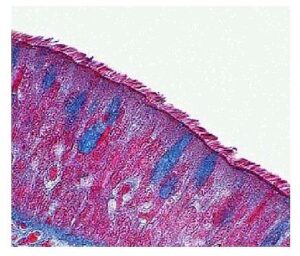
The modified structures at the border of the epithelium shown above are immotile in a 23-year-old patient. Which of the following would be a consequence of this lack of motility?

19 04, 2021

Q290

By |2021-04-19T20:36:56+00:00April 19, 2021|Question Banks|0 Comments

A patient with tuberculosis develops bright orange-red urine and calls his physician in a panic because he is afraid he is bleeding into the urine. The patient has no other urinary tract symptoms. Which of the following medications is most likely to produce this side effect?

19 04, 2021

Q260

By |2021-04-19T20:36:58+00:00April 19, 2021|Question Banks|0 Comments

A 32-year-old, blood type A positive male receives a kidney transplant from a blood type B positive female donor with whom he had a 6-antigen HLA match. Once the kidney is anastomosed to the man's vasculature, the transplant team immediately begins to observe swelling and interstitial hemorrhage. After the surgery, the patient developed fever and leukocytosis and produced no urine. Which of the following is the most likely explanation?

19 04, 2021

Q261

By |2021-04-19T20:36:57+00:00April 19, 2021|Question Banks|0 Comments

A cardiovascular physiologist is performing experiments using a new alpha1 adrenergic agonist to determine the amount of vasoconstriction the new drug can produce compared with a phenylephrine control. Which of the labeled structures is the cellular target of both of these drugs?

16 04, 2021

Q251

By |2021-04-19T20:36:59+00:00April 16, 2021|Question Banks|0 Comments

An 80-year-old woman dies after a long history of progressive memory loss, apraxia, and recurrent episodes of confusion. In the last months of life she was bedridden and unable to recognize familiar faces and objects. The pathologist identifies numerous flame-shaped intracytoplasmic inclusions in neurons of the neocortex and hippocampus. These consist of paired helical filaments (PHFs) on electron microscopy. Which of the following biochemical changes most likely accounts for the development of PHFs in this condition?

16 04, 2021

Q250

By |2021-04-19T20:36:59+00:00April 16, 2021|Question Banks|0 Comments

A 71-year-old man has been in excellent health, and practicing competently as an attorney. He is brought to the emergency room following a motor vehicle accident. A workup, including imaging of the spine, thorax, and head, is negative, but the patient is admitted for overnight observation. His injuries include several lacerations to the face and extremities as well as several contusions to the thorax. Three weeks later, he is admitted to the hospital for confusion. A neurologic exam is normal except that he is not oriented to time or place, and can recall only 1 out of 6 objects after 3 minutes. Which of the following is the most likely diagnosis?

Go to Top